An AI mobile app should help a person finish a useful task. Start there, rather than with a long feature list. Choose one user, one input and one result they can inspect. Then make that path work when the network, the model or the user interrupts it.
This guide is for founders and product teams considering their first AI-powered app. You do not need to rebuild your whole business to test a good idea.
Start with the finished task
Write a sentence such as: "A service coordinator can turn an incoming description into a draft request, check the details and pass it to a colleague."
That is easier to evaluate than "an AI assistant for everything." It tells you who needs the product, what they provide and what a successful result looks like. It also makes exclusions easier: payment processing, automatic approvals and a full customer portal might belong in a later phase.
Ask whether the task needs a mobile app at all. A responsive website may be enough for an early test. A native app may be useful when device features, an app-store distribution route or a repeat-use mobile experience matter. Choose the delivery format for the user's situation, not for a presentation slide.
A concrete example: InterviewCoach
Our InterviewCoach demo illustrates a short path: use your background, practise answering questions and return to a review with strengths, gaps and recommendations. The Android app is available through Google Play.
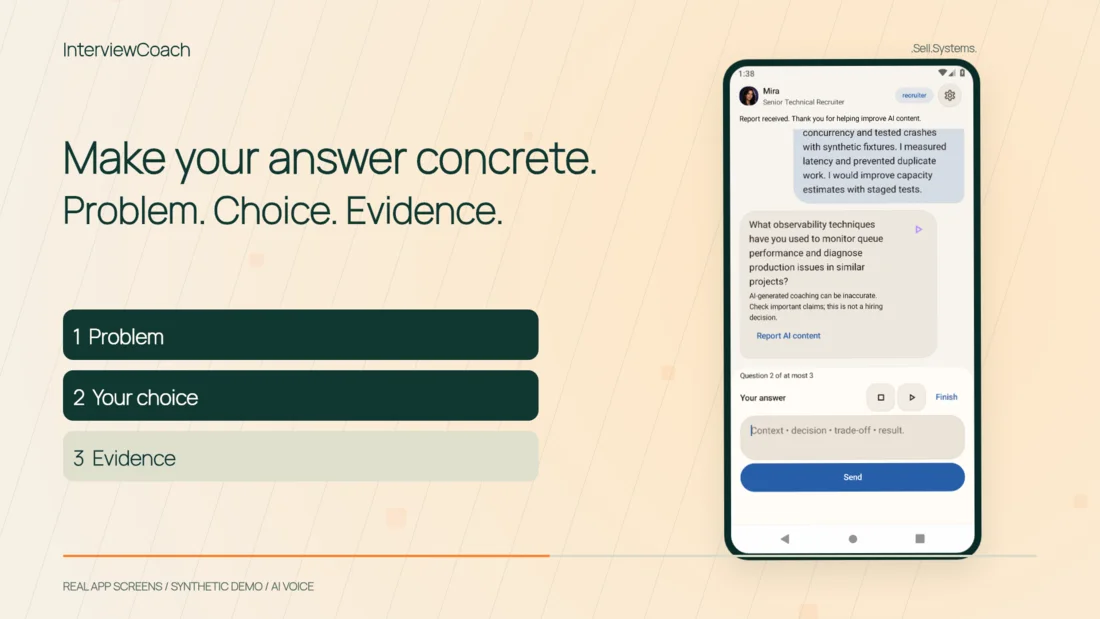
The preview comes from our creative video, which contains illustrative QA data, actual app screens and AI narration. It is not a customer testimonial, the founder's interview or evidence that someone received a job offer. InterviewCoach is a practice tool, not a hiring decision.
The transferable lesson is the complete path. An AI reply becomes useful when a person can understand it, correct mistakes and act on it. The same product pattern can support document preparation, service intake or an internal business handoff. Each use case still needs its own requirements and validation.
Separate the app from the model
Plan three boundaries: the user interface, the application backend and the model provider. The backend controls requests, credentials, validation and persistence. The model contributes an interpretation or draft; it should not silently become the authority for every business decision.
Hosting the application on your server does not mean an external model runs there. Explain which data crosses that boundary, who holds the provider account and how usage is paid. A later provider change is easier when application records and evaluation cases do not depend on a particular model's prose.
Read when AI should run on your own server before making a self-hosting promise.
Agree on the first acceptance checks
Before development, collect a small set of permitted examples. Include incomplete input, an unreadable document, a slow response, a lost connection and a user returning after closing the app.
For each case, write the expected result. "A saved review opens again" is observable. "The app feels intelligent" is not a useful acceptance check. Keep factual correctness separate from visual polish: a beautiful answer can still be wrong.
Our AI request reliability guide covers the recovery questions behind that first path. Security, privacy and store submission checks belong in the plan, not as last-minute decorations.
Make operating costs visible
Your first quote should separate discovery, implementation, hosting, model usage, third-party licences and ongoing support. An app-store approval is not proof of demand, and a small demo is not an unlimited production commitment.
Choose an initial measurement that matches the user's task: completion, useful corrections or a confirmed handoff. Downloads and video views can tell you about attention; they cannot prove business value on their own.
For a purchasing checklist, read what to include in a first AI app pilot.
Your useful next step
Write down the person, input, finished result and three examples that should work. That brief is a strong starting point for a scope discussion.
If you want help turning it into a bounded build, book a free 15-minute Google Meet intro. The introductory call is free; implementation and operation are separately agreed paid services.